There is a gentle, timeless question that humanity has always carried in its heart: How do we live long, healthy, and meaningful lives?
The ancient Tamil Siddhas, mystics of South India, answered this question through a practice known as Kaya Kalpa—a science of rejuvenation that nourishes body, mind, and spirit. One of the greatest Siddhas, Agathiyar, lovingly preserved this wisdom in his Paripooranam, showing us that true longevity is not just about adding years to life but adding life to years.
Today, as modern life races faster than ever, this wisdom feels fresh, healing, and urgently needed.
What Is Kaya Kalpa?
The word Kaya Kalpa comes from Tamil and Sanskrit roots:
- Kaya means “body.”
- Kalpa means “transformation” or “renewal.”
Together, Kaya Kalpa means the transformation of the body into a state of radiant vitality.
It is not merely about physical health—it is about restructuring the body and mind so they can carry divine consciousness. The Siddhas saw the body as a sacred temple. If the temple is weak or neglected, the inner light cannot shine fully. Kaya Kalpa repairs, purifies, and strengthens this temple so that life flows in its fullest expression.
The Siddha Vision of Longevity
In the modern world, longevity is often measured in numbers—how many birthdays we can count. But Agathiyar and the Siddhas had a different vision:
- To live long is to live with clarity of mind.
- To live long is to live with strength in body.
- To live long is to live with compassion in heart.
- To live long is to live in union with the Divine.
Longevity, then, is not about resisting age but about aging into wisdom, vitality, and wholeness.
The Pillars of Kaya Kalpa
Agathiyar describes several key principles that sustain the Kaya Kalpa path. While some involve rare herbs and alchemical preparations, many are timeless practices accessible to us today.
1. Breath as Medicine
The Siddhas taught that breath (prana) is life itself. When the breath is shallow and restless, the body ages quickly. When the breath is deep, slow, and mindful, the body rejuvenates naturally.
- Practice: Spend a few minutes daily observing your breath. Slow it down, lengthen the exhalation, and feel the calm spread through your body.
2. Food as Nourishment, Not Indulgence
Agathiyar emphasized simple, sattvic (pure) foods that nourish rather than burden the body. Herbs, roots, greens, and wholesome grains were not just meals—they were medicine.
- Practice: Eat with awareness. Choose foods that bring energy and clarity rather than heaviness. Let food be a prayer, not a distraction.
3. Herbs as Allies
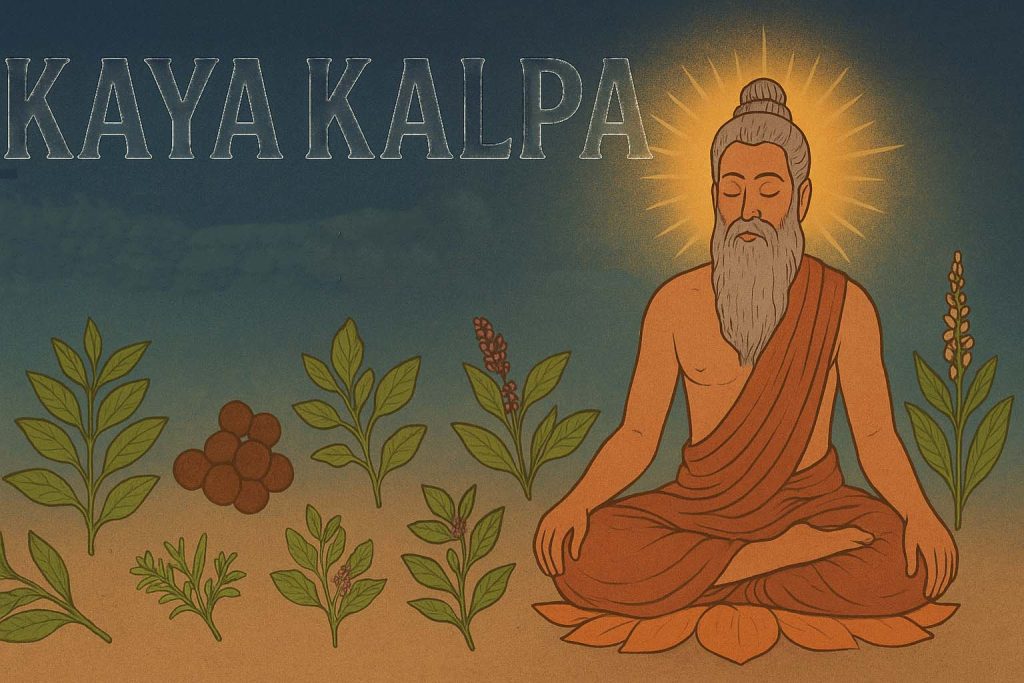
Kaya Kalpa often includes powerful herbs like amukkara (ashwagandha), kadukkai (haritaki), karunthulasi (black tulsi), and avaram poo (tanner’s cassia flower). These herbs support digestion, strengthen immunity, calm the nerves, and renew cells.
- Practice: Explore gentle herbal teas and tonics. Even simple herbs like tulsi or ginger can renew vitality when taken with reverence.
4. Rest as Renewal
Agathiyar knew the value of deep rest. True rest is not just sleep, but a stillness of mind that refreshes the body.
- Practice: Create moments of silence each day. Step away from screens, close your eyes, and let the mind rest in quiet awareness.
5. Service as Healing
The Siddhas discovered a profound truth: when you serve others with love, your own body and mind rejuvenate. Compassion is not just good for the soul—it is medicine for the body.
- Practice: Do one act of service each day. It may be as small as listening to someone or offering a kind word. These small acts create a large reservoir of inner vitality.
The Mystical Dimension of Kaya Kalpa
Beyond health and herbs, Kaya Kalpa had a deeper mystical purpose: to prepare the body for divine consciousness.
The Siddhas believed that the human body has the potential to become a vessel of immortality—not through avoiding death, but through realizing the eternal nature of the soul. Kaya Kalpa keeps the body vibrant so that the spirit can awaken fully.
In this sense, longevity is not about clinging to life but about living so radiantly that the boundary between body and soul becomes thin, transparent, and luminous.
Kaya Kalpa in Modern Life
You may wonder: Can these ancient practices really apply to today’s world of stress, screens, and fast food? The answer is a loving yes.
Here are simple Kaya Kalpa-inspired practices you can try:
- Morning Breath Ritual – Begin your day with 10 slow, deep breaths. This sets a calm rhythm for your body and mind.
- Gratitude Meal – Before eating, pause and give thanks. Eat slowly, savoring the life energy in your food.
- Daily Herbal Companion – Enjoy a warm cup of tulsi or ginger tea as a daily tonic.
- Digital Sunset – Turn off devices an hour before bed. Let your mind rest in stillness.
- Compassion Journal – Write down one act of kindness you offered or received each day. Watch how it renews your spirit.
Even these small steps can bring profound changes when practiced with love and consistency.
Agathiyar’s Promise of Renewal
Agathiyar reminds us that Kaya Kalpa is not about chasing youth or fearing age. It is about discovering the ever-renewing life within us. Just as the tree sheds leaves and blossoms again, so too can the human spirit continually refresh itself.
When we live with mindful breath, nourishing food, healing herbs, deep rest, and compassionate service, we do more than extend our years—we expand our life’s depth and radiance.
Conclusion: A Life That Glows
Kaya Kalpa is not a secret hidden in mountains. It is a wisdom waiting in your breath, your plate, your heart, and your moments of stillness.
Agathiyar’s message is simple and timeless:
✨ Your body is sacred. Care for it.
✨ Your mind is powerful. Quiet it.
✨ Your spirit is eternal. Awaken it.
To practice Kaya Kalpa is to honor life itself. It is to walk through each day with gratitude, vitality, and love. And in doing so, we discover the true secret of longevity: not merely to live long, but to live deeply, wholly, and divinely.